Months passed before the criminal proceedings reached a decisive stage.
The prosecutors presented their case through witnesses, authenticated recordings, phone records, and the documented chain of custody for the recovered handgun.
The defense challenged what each item proved and offered alternative interpretations.
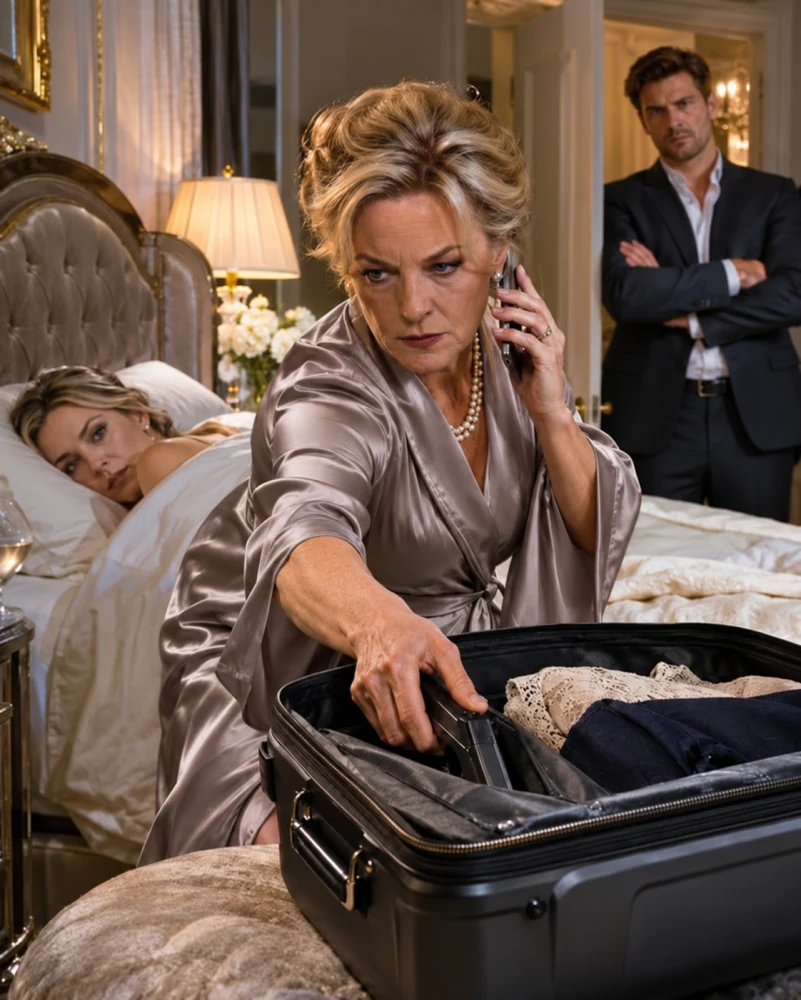
I attended only when required and gave testimony about the camera, the suitcase, the calls, and my actions after waking.
I did not claim to hear Preston's reply during Lorraine's bedroom call.
I did not pretend to know what was inside the dark object at the moment it was placed.
Preparing to testify had been emotionally harder than performing the testimony itself.
I worried that a mistaken date would make everything else sound uncertain.
Daniel helped me review the records without scripting answers.
I explained what the recording showed and what the investigators later established.
The distinction mattered.
During cross-examination, Preston's attorney asked why I had installed the camera.
“Because someone had repeatedly entered my bedroom without permission,” I answered.
“Were you already suspicious of my client's family?”
“I was concerned about unexplained access to my belongings.”
I worried that a mistaken date would make everything else sound uncertain.
Daniel helped me review the records without scripting answers.
Ortega reminded me that saying I did not know was sometimes the most accurate answer.
“Isn't it true you wanted control of Lawson Holdings?”
“I already owned fifty-two percent of its voting shares.”
A quiet murmur moved through the courtroom.
The judge reminded everyone to remain silent.
The prosecutor showed the court the timing of Lorraine's actions and the subsequent six o'clock report.
An investigator explained the evidence supporting the caller's identification without speculating beyond the records.
Daniel helped me review the records without scripting answers.
I returned to the witness preparation in my thoughts because it revealed something I had initially missed.
My father used to remind me that the smallest discrepancy deserved attention when it affected the people who depended on us.
I had learned that the cleanest form of strength was often an unglamorous willingness to follow the evidence.
When I closed the notebook, I was still uncertain about the outcome, but no longer uncertain about why I was continuing.
Ortega reminded me that saying I did not know was sometimes the most accurate answer.
I carried that advice into the courtroom.
Another witness described Preston's statements about my planned Chicago meeting.
I watched my husband stare at the table while those statements were examined.
I had imagined that seeing him exposed would satisfy me.
It did not.
It only made the waste of our marriage feel more undeniable.
After the evidence and arguments, the case concluded with findings against both defendants on charges supported by the court's verdict.
Ortega reminded me that saying I did not know was sometimes the most accurate answer.
I carried that advice into the courtroom.
What stayed with me about the contested evidence was not the spectacle but the ordinary decision beneath it.
I was beginning to understand that protecting a company meant protecting its decision-making process, including the people who challenged it.
I could not control what Preston said, what Lorraine believed, or how strangers interpreted a photograph.
I left the question where it belonged, with the records and the people responsible for examining them.
The truth did not require me to be perfect.
The precise legal consequences were determined through the court process rather than by my wishes.
The court rejected the suggestion that the suitcase incident had been an innocent joke.
The judge emphasized the gravity of deliberately creating the appearance of criminal conduct by another person.
Lorraine looked smaller without her familiar audience.
Preston avoided my eyes.
Looking back at the courtroom atmosphere, I could identify the exact moment I stopped accepting appearances as answers.
There was comfort in admitting what I did not know, because it allowed investigators, auditors, and attorneys to do the work they were qualified to do.
I could control whether I kept records, sought competent advice, and refused to repeat a claim I could not support.
It was a small act of self-respect, almost invisible from the outside, and precisely the kind I had neglected for years.
When I stepped outside, reporters shouted questions.
I carried that advice into the courtroom.
The truth did not require me to be perfect.
It required me not to turn uncertainty into certainty for the sake of effect.
One asked if I was happy.
I considered the word.
“No,” I said.
“I'm grateful the evidence was heard.”
Another asked whether I wanted them to suffer.
“I want accountability and a life that is no longer organized around their choices,” I replied.
The truth did not require me to be perfect.
It required me not to turn uncertainty into certainty for the sake of effect.
Afterward, Ruth asked whether I had seen the way the judge listened carefully to the witnesses.
Then I walked away with Daniel and my aunt Ruth.
We ate lunch at a small restaurant across the street.
Ruth ordered soup.
Daniel spilled water on his tie.
For the first time in months, I laughed without wondering whether the sound would upset somebody.
The verdict did not return the years I had lost.
It required me not to turn uncertainty into certainty for the sake of effect.
Afterward, Ruth asked whether I had seen the way the judge listened carefully to the witnesses.
I said yes.
It did not repair every consequence of the financial misconduct.
But it ended the lie that I had imagined the events of that night.
And it made clear that I had never been the person who put danger in my suitcase.
Afterward, Ruth asked whether I had seen the way the judge listened carefully to the witnesses.
I said yes.
I also noticed how carefully the defense was permitted to challenge the evidence.
That was not a weakness of the process.
It was part of what made the result meaningful.
In the weeks that followed, I avoided replaying courtroom clips online.
Other people could debate expressions and clothing.
I had heard enough testimony to know what mattered.
I returned to the slow work of living.