Spring arrived slowly.
The roses bloomed again, first a few stubborn buds and then an entire wall of color along the front fence.
Linda returned to her habit of spending an hour in the garden near sunset.
I often parked my truck and found her pruning a branch or speaking to a neighbor.
Each time I saw her through the gate, I remembered that afternoon with the grocery bag and felt a flicker of anger.
The anger didn't rule me anymore.
It reminded me why boundaries mattered.
The legal matters reached their conclusions on different schedules.
The bank confirmed in writing that no loan secured by our home had been issued and that it had removed the disputed authority from its records.
Our property search showed no unauthorized deed or lien.
In the separate document investigation, Ethan accepted responsibility through a resolution negotiated with counsel and subject to the applicable legal process.
He faced financial restitution requirements and other consequences.
I won't pretend it was painless to see my son confronted with the results of his choices.
It hurt deeply.
But when he told us that he was complying with the terms and rebuilding his finances, I believed he was finally learning that making things right costs more than saying sorry.
Ashley's company ceased its effort to acquire our property, and the investor dispute continued toward its own settlement.
We didn't need every argument in the world to end before we could enjoy breakfast.
We had secured what mattered most.
Linda chose to hold a small dinner for the neighbors who had checked on her and the friends who had quietly offered support.
She cooked chicken, roasted vegetables, and the lemon cake Ethan had loved as a boy.
I asked whether that dessert would make the evening harder.
“I'm making it because I like it,” she said.
“It doesn't belong to him.”
The distinction made me smile.
Our son was invited for dessert after the guests left, a choice Linda made freely after months of cautious meetings and consistent respectful behavior.
He arrived at the arranged time and rang the bell.
He didn't presume he could walk in.
On the morning of the dinner, Linda sent me to the store for lemons.
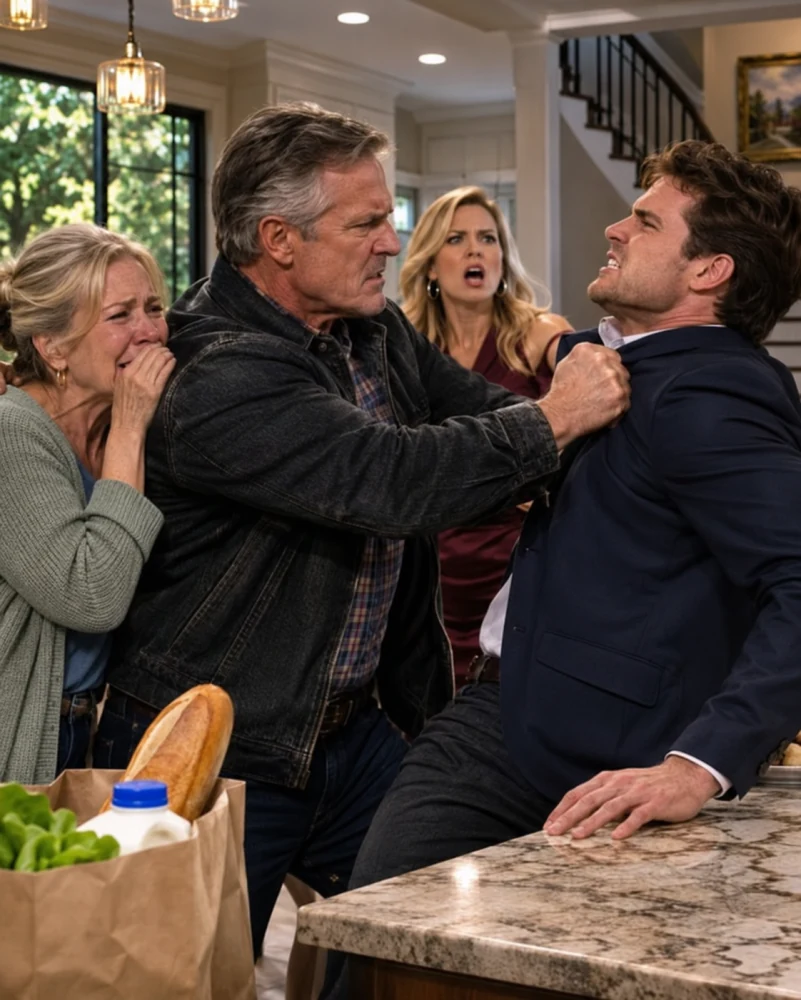
I found myself standing in the produce aisle with a paper bag in my hand, remembering the bag she had held outside our gate.
It was an ordinary object, but my body remembered the shock of seeing it pressed to her chest.
For a brief moment I couldn't move.
Then I bought the lemons and drove home.
Linda was humming in the kitchen when I returned.
I told her what had happened.
She listened and said that sometimes a memory can make the present feel dangerous even when it isn't.
We stood together until the feeling passed.
Then she handed me a knife and asked me to cut the lemons for the cake.
There was work to do, and we could do it side by side.
Later, as guests arrived, Linda welcomed them at the front door rather than through the garden.
I saw her smile at each familiar face.
We had not hidden the story from those closest to us, but we did not make the evening into a celebration of Ethan's failures.
We thanked our friends for their kindness and spoke about the garden, community projects, and ordinary plans for summer.
One neighbor offered to help build a trellis for the roses.
Linda eagerly accepted.
The living room sounded like our home again.
After the last guest left, she sat for a brief moment beneath the photograph we had kept above the sink.
“I didn't want a victory over my son,” she told me.
“I wanted a life where I didn't have to be afraid of him.”
I told her that was what we had worked toward.
We couldn't promise never to be hurt again, and we couldn't guarantee every choice Ethan would make.
But we could protect our choices, our finances, and the right to close our own door.
When the bell rang for the arranged dessert visit, we looked at each other before answering.
It was not fear.
It was a shared decision.
She nodded.
I opened the door.
The sound was ordinary.
To us, it meant something.
We opened the door together.
He hugged his mother only after she lifted her arms.
He shook my hand before I pulled him into an embrace.
We sat at the kitchen table under the familiar light and ate lemon cake.
No one spoke about investment deals, inheritance, or renovations.
Ethan asked Linda about the roses.
She told him which ones had survived the winter and which needed pruning.
He listened.
After dessert, he offered to wash the dishes.
Ashley had once looked at those dishes as chores beneath her.
Ethan washed each plate carefully and set it on the rack.
Linda watched him with an expression I couldn't fully read.
When he finished, he stopped near the pantry doorway where his childhood height marks still ran up the frame.
“You kept them,” he said.
“Of course,” Linda replied.
“What happened doesn't erase the years before it.”
He touched the highest mark.
“I made a mess of things.”
“Yes,” I said.
“You did.”
He nodded.
“I won't ask you to pretend otherwise.”
That was the most hopeful thing he said all evening.
When it was time to leave, I walked him to the gate.
I entered the code myself.
He didn't ask what it was.
We stood in the gentle night air, two men connected by love, injury, and a long stretch of work still ahead.
“Dad,” he said, “I thought the house was proof you'd taken care of me.”
I watched the gate swing open.
“It was proof your mother and I had taken care of each other,” I replied.
“We took care of you because you were our son, not because you were owed the building.”
He looked back at the glowing windows.
“I understand now.”
I gave no answer with a promise I couldn't guarantee.
I squeezed his shoulder and watched him walk to his car.
Then I closed the gate and returned to Linda.
She was waiting in the kitchen with two cups of tea.
I thought about the day I'd come home and found her locked outside, about the fury that had carried me through the side entrance, and about the words I'd spoken to Ethan.
Tonight you're going to find out who truly owns this family.
I understood those words differently now.
No one owns a family.
A family is something people choose to honor, especially when entitlement would be easier.
Ethan still had debts to repay and trust to rebuild.
Linda and I still had years to fill with ordinary days.
The house stood around us, imperfect and solid, its walls holding memories we no longer needed to surrender to keep the peace.
Linda reached across the table and took my hand.
“I'm glad you came home when you did,” she said softly.
I looked at the woman I'd loved for thirty-eight years.
“So am I,” I said.
Outside, the gate was locked.
Inside, nobody needed permission to belong.